

Home > PAIN > Varicose Treatments
Varicose Vein Treatment at 300 Middletown Blvd Suite 103, Langhorne, PA 19047 — Cellara Pain Institute
Varicose vein treatment is one of Cellara Pain Institute’s core specialties. Whether you are seeking relief from painful, swollen leg veins or want to understand how to get rid of varicose veins that have worsened over time, Dr. Mohamed Osman delivers minimally invasive vein treatment at 300 Middletown Blvd Suite 103, Langhorne, PA 19047, using in-office procedures with same-day duplex ultrasound. Both the medical and cosmetic impact of varicose veins deserve expert attention. Same-week vein consultation is available for patients throughout Bucks County and Langhorne.
What Are Varicose Veins?
Varicose veins (Entity-Type: vascular condition) are swollen, twisted, rope-like veins visible just beneath the skin surface (Attribute) that develop when the one-way valves inside leg veins fail to keep blood flowing upward toward the heart, allowing it to pool and cause the vein wall to bulge outward (Value). They most commonly appear in the legs and feet, where venous pressure is highest.
Varicose veins affect an estimated 23 percent of adults in the United States and are more prevalent in women, older adults, and people with a family history of vein disease. They range from a cosmetic concern to a progressive medical condition that causes daily pain, swelling, skin changes, and in advanced cases, venous ulcers.
Varicose veins are not the same as spider veins. Spider veins are smaller, web-like clusters of dilated capillaries at the skin surface that rarely cause symptoms beyond their appearance. Varicose veins involve the larger superficial venous system and are more likely to progress and cause medical complications without treatment.
What Causes Varicose Veins?
Varicose veins are caused by chronic venous hypertension resulting from faulty venous valves. Faulty venous valves (Entity) allow blood to flow backward and pool in the leg veins (Attribute), causing progressive dilation, twisting, and surface bulging of the vein wall (Value). This mechanism, called venous reflux, is the underlying pathophysiology of nearly all varicose vein disease.
The following risk factors increase the likelihood of developing venous valve failure and varicose veins:
- Age: Vein valve function naturally weakens over time. Adults over 50 have significantly higher rates of varicose vein disease than younger populations.
- Sex (female): Females are affected roughly twice as often as males. Hormonal fluctuations during menstruation, pregnancy, and menopause promote vein wall laxity.
- Pregnancy: Pregnancy (Entity) increases total blood volume and compresses pelvic veins (Attribute), elevating venous pressure in the leg veins and accelerating valve failure (Value). Varicose veins during pregnancy are common and may partially resolve postpartum, but often persist or worsen with subsequent pregnancies.
- Family history and genetics: Varicose veins are strongly hereditary. If both parents have varicose veins, the lifetime risk approaches 90 percent. Genetic factors govern connective tissue strength in the vein wall.
- Prolonged standing or sitting: Occupations requiring prolonged standing (nursing, retail, food service) or prolonged sitting elevate venous pressure in the lower legs and accelerate valve deterioration.
- Obesity: Excess body weight increases intraabdominal pressure, restricting venous return from the legs and increasing the mechanical load on leg vein valves.
- Prior leg injury or surgery: Trauma to leg veins, prior deep vein thrombosis, or prior venous surgery can damage valves or alter venous anatomy, contributing to varicose vein development.
What Are the Symptoms of Varicose Veins, and When Should I Worry?
Varicose veins produce a characteristic set of symptoms that worsen progressively as venous hypertension increases. Symptoms are typically more prominent after prolonged standing and improve with leg elevation.
Common Varicose Vein Symptoms
- Aching, heaviness, or fatigue in the legs, particularly toward the end of the day
- Throbbing, burning, or cramping pain in the calf or thigh, often worsening with heat or prolonged standing
- Visible bulging, rope-like veins beneath the skin surface of the legs
- Swelling (edema) in the ankles and lower legs
- Itching around the varicose vein (a sign of skin inflammation from venous hypertension)
- Skin discolouration or brownish staining around the ankle (lipodermatosclerosis or hemosiderin deposition)
- Restless legs at night associated with underlying venous disease
- Venous eczema: dry, flaky, or weeping skin over varicose veins
WHEN TO SEEK PROMPT MEDICAL EVALUATION
- Bleeding from a varicose vein (veins near the skin surface can rupture, causing significant blood loss)
- Open skin ulcer near the ankle that does not heal (venous leg ulcer — a sign of advanced chronic venous insufficiency)
- Sudden increase in pain, redness, or warmth along a varicose vein (possible superficial thrombophlebitis)
- Rapid increase in swelling of one entire leg (this symptom pattern warrants DVT evaluation, a separate vascular condition)
- Skin thickening, hardening, or darkening around the ankle (lipodermatosclerosis — advanced CVI requiring urgent vein evaluation)
A note on varicose veins and cancer: patients sometimes search whether varicose vein symptoms could indicate cancer. Bulging or painful leg veins are caused by venous valve failure and venous hypertension, not by cancer. This question is addressed directly in the FAQ section below.
Symptoms alone do not tell the full clinical picture. A duplex ultrasound examination is required to confirm the source and severity of venous reflux. The next section explains how Cellara Pain Institute diagnoses varicose veins accurately and efficiently.
Are Varicose Veins Dangerous, or Just a Cosmetic Problem?
Varicose veins are caused by chronic venous hypertension resulting from faulty venous valves. Faulty venous valves (Entity) allow blood to flow backward and pool in the leg veins (Attribute), causing progressive dilation, twisting, and surface bulging of the vein wall (Value). This mechanism, called venous reflux, is the underlying pathophysiology of nearly all varicose vein disease.
The following risk factors increase the likelihood of developing venous valve failure and varicose veins:
- Age: Vein valve function naturally weakens over time. Adults over 50 have significantly higher rates of varicose vein disease than younger populations.
- Sex (female): Females are affected roughly twice as often as males. Hormonal fluctuations during menstruation, pregnancy, and menopause promote vein wall laxity.
- Pregnancy: Pregnancy (Entity) increases total blood volume and compresses pelvic veins (Attribute), elevating venous pressure in the leg veins and accelerating valve failure (Value). Varicose veins during pregnancy are common and may partially resolve postpartum, but often persist or worsen with subsequent pregnancies.
- Family history and genetics: Varicose veins are strongly hereditary. If both parents have varicose veins, the lifetime risk approaches 90 percent. Genetic factors govern connective tissue strength in the vein wall.
- Prolonged standing or sitting: Occupations requiring prolonged standing (nursing, retail, food service) or prolonged sitting elevate venous pressure in the lower legs and accelerate valve deterioration.
- Obesity: Excess body weight increases intraabdominal pressure, restricting venous return from the legs and increasing the mechanical load on leg vein valves.
- Prior leg injury or surgery: Trauma to leg veins, prior deep vein thrombosis, or prior venous surgery can damage valves or alter venous anatomy, contributing to varicose vein development.
How Are Varicose Veins Diagnosed at Cellara Pain Institute?
Varicose vein diagnosis at Cellara Pain Institute (Entity) combines a targeted physical examination with in-office duplex ultrasound (Attribute), which maps venous valve function and identifies the exact pattern of venous reflux in 20 to 30 minutes during your first appointment (Value).
No referral or separate imaging center visit is required. The duplex ultrasound is performed at Cellara, the results are reviewed by Dr. Osman the same day, and your treatment plan is developed immediately following the scan.
The diagnostic process at Cellara includes:
- Comprehensive venous history: symptom duration, severity, functional impact, prior treatments, and relevant risk factors
- Physical examination: visual assessment of vein distribution, skin changes, edema, and CEAP clinical classification (C0 through C6)
- In-office duplex ultrasound: real-time color-flow imaging of the superficial and deep venous systems to detect valve reflux, identify the origin of disease (great saphenous vein, small saphenous vein, or perforating veins), and measure reflux duration
- CEAP classification: the internationally standardized staging system for chronic venous disease, used to communicate severity and support insurance prior authorization
- Insurance pre-authorization support: Cellara’s care team initiates the prior authorization process for medically necessary vein procedures before you leave the clinic
Same-day diagnosis advantage: most patients leave their first Cellara vein appointment with duplex ultrasound results, a CEAP classification, a written treatment plan, and the insurance prior-authorization process underway. This is not standard at most vein clinics
With a precise diagnosis confirmed, Dr. Osman recommends the most appropriate treatment approach. The next section presents the full range of varicose vein treatments available at our Langhorne, PA 19047 practice.
Varicose Vein Treatment Options: From Compression to Minimally Invasive Procedures
Varicose vein treatment at Cellara Pain Institute (Entity) follows an evidence-based, tiered approach (Attribute) beginning with compression therapy and progressing to in-office minimally invasive procedures that permanently close affected veins and redirect blood to healthy vessels (Value). All procedures are performed personally by Dr. Mohamed Osman.
▸ Tier 1 — Conservative and Supportive Care
Compression Stockings and Compression Socks
Compression stockings (Entity) apply graduated external pressure to the leg veins (Attribute), improving venous blood return toward the heart and reducing the pooling that causes varicose vein symptoms (Value). Medical-grade compression (20 to 30 mmHg, or 30 to 40 mmHg for advanced disease) is recommended over over-the-counter socks.
Important limitation: compression stockings relieve symptoms and slow disease progression but do not close or eliminate varicose veins. Most insurance plans require a documented trial of compression therapy (typically six to twelve weeks) before authorizing minimally invasive procedures. Cellara initiates this documentation from your first appointment.
▸ Tier 2 — Minimally Invasive In-Office Procedures
Endovenous Laser Treatment (EVLT)
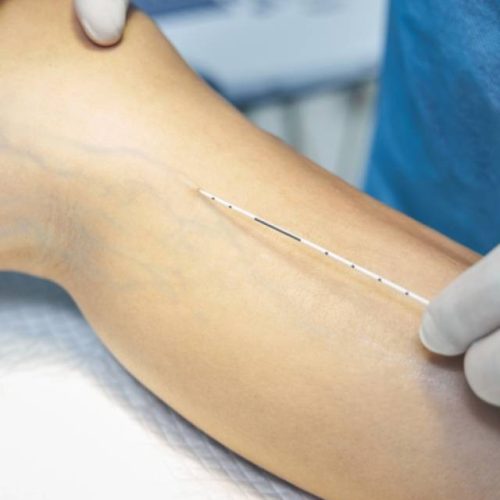
Endovenous laser treatment (EVLT) (Entity) uses laser energy delivered through a thin fiber inserted inside the vein under ultrasound guidance (Attribute) to heat and seal the vein wall permanently, causing the treated vein to collapse and be reabsorbed by the body over several weeks while blood reroutes to healthy veins (Value). EVLT is the gold-standard first-line treatment for great saphenous vein and small saphenous vein reflux.
- Performed in-office under local anesthesia
- No general anesthesia or hospital admission required
- Procedure time: approximately 45 to 60 minutes
- Return to normal activity: same day to 24 hours
- 5-year closure rates: greater than 90 percent in clinical trials
Varithena Foam Sclerotherapy
Varithena (Entity) is an FDA-approved polidocanol microfoam injectable treatment for varicose veins of the great saphenous vein system (Attribute) that is injected under ultrasound guidance and displaces blood within the vein, causing the vessel wall to collapse and seal without a catheter or laser fiber (Value). It is particularly suited for tortuous veins, veins with prior treatment, and patients with anatomy that makes catheter-based procedures less feasible.
- Single injection session in most cases
- No incisions or anesthesia beyond a small injection
- Visible improvement typically within four to eight weeks
Liquid Sclerotherapy
Sclerotherapy for varicose veins (Entity) involves injecting a liquid sclerosant solution directly into the vein using a fine needle (Attribute), damaging the vein wall and causing it to collapse and gradually fade over several weeks (Value). Liquid sclerotherapy is most effective for smaller varicose veins and residual varicosities after thermal ablation of the main trunk vein.
- Two to four sessions typically required for optimal clearance
- Sessions spaced four to six weeks apart
- In-office, no anesthesia required
- Can be combined with EVLT or RFA in the same treatment plan
Can Varicose Veins Go Away on Their Own, or Do They Always Need Treatment?
Varicose veins (Entity) do not resolve spontaneously (Attribute) because the underlying valve damage that caused them is permanent and irreversible (Value). Once a vein valve fails, the reflux it generates is ongoing, and the vein will continue to enlarge and worsen over time without intervention.
The one exception is varicose veins that develop during pregnancy. Pregnancy-related varicose veins often improve significantly within three to six months postpartum as blood volume normalizes and pelvic compression is relieved. However, veins that persist beyond six months postpartum are unlikely to resolve further and are candidates for treatment.
Compression stockings slow the progression of varicose veins and reduce symptoms effectively, but they do not close the diseased vein or restore valve function. Treatment is the only mechanism by which varicose veins are permanently eliminated.
The question is not whether to treat varicose veins but when. Earlier treatment generally achieves better outcomes with lower complexity, lower cost, and a reduced risk of complications such as skin ulceration and phlebitis.
The next section presents the clinical and practical advantages of choosing minimally invasive treatment over watchful waiting or open surgery.
What Are the Benefits of Minimally Invasive Varicose Vein Treatment vs Surgery?
Minimally invasive vein procedures at Cellara Pain Institute (Entity) offer significant advantages over open surgical vein stripping for Persona E patients who want effective treatment with minimal disruption to their lives (Attribute), delivering equivalent or superior long-term closure rates without the risks of general anesthesia, hospitalization, or extended recovery (Value).
- No general anesthesia: all minimally invasive vein procedures at Cellara are performed under local tumescent anesthesia only. No sedation, no fasting requirement, no anesthesiologist.
- In-office convenience: procedures are performed at our Doylestown clinic, not in a hospital or surgical center. Patients drive themselves home in most cases.
- Same-day or next-day return to activity: most patients return to light activity, walking, and desk work the same day. Medical compression stockings are worn for a short period post-procedure.
- No large incisions: thermal ablation and foam injection leave no significant scarring, in contrast to surgical vein stripping which required incisions at the groin and multiple points along the thigh.
- Superior long-term outcomes: five-year clinical data shows EVLT achieves recurrence rates comparable to or better than surgical stripping, with significantly lower complication rates and patient-reported higher satisfaction.
- Dual relief: minimally invasive vein treatment addresses both the medical condition (valve failure, venous hypertension) and the cosmetic appearance of bulging veins, delivering results that matter to Persona E on both dimensions.
What Should I Expect at My First Varicose Vein Appointment at Cellara?
- Step 1 — History and symptom review: Duration of symptoms, prior treatments, compression stocking use, relevant medical history, and your personal goals (medical relief, cosmetic improvement, or both).
- Step 2 — Physical examination: Visual and tactile assessment of vein distribution, skin changes, edema pattern, and initial CEAP clinical classification.
- Step 3 — In-office duplex ultrasound: Real-time mapping of the superficial and deep venous systems using color-flow ultrasound. This identifies the specific vein segments with valve failure, reflux duration, and any deep vein involvement. Results are available immediately.
- Step 4 — Treatment planning: Osman reviews ultrasound findings with you, explains the diagnosis, and recommends the most appropriate procedure or sequence of procedures.
- Step 5 — Insurance pre-authorization: For symptomatic varicose veins meeting medical necessity criteria, Cellara’s care team initiates insurance pre-authorization documentation before you leave.
How Long Does Varicose Vein Treatment Take, and How Quickly Will I See Results?
| Procedure | Duration / Sessions | Recovery and Results |
|---|---|---|
| Endovenous Laser Treatment (EVLT) | 45 to 60 min in-office, 1 session | Same-day activity; visible improvement 4 to 8 weeks; closure confirmed by 3-month ultrasound |
| Radiofrequency Ablation (RFA / ClosureFast) | 45 min in-office, 1 session | Same-day activity; equivalent timeline to EVLT; less post-procedure bruising in many patients |
| Varithena Foam Sclerotherapy | 30 to 45 min, typically 1 to 2 sessions | Visible improvement within 4 to 8 weeks; residual veins may need sclerotherapy follow-up |
| Liquid Sclerotherapy | 20 to 30 min per session, 2 to 4 sessions | Sessions spaced 4 to 6 weeks; full results visible 8 to 12 weeks after final session |
| Combined plan (e.g., EVLT + sclerotherapy) | Two separate visits, 4 to 6 weeks apart | Staged approach for comprehensive clearance; timeline 10 to 16 weeks total |
Frequently Asked Questions About Varicose Vein Treatment
Varicose veins are swollen, twisted superficial veins that develop when the one-way valves inside leg veins fail, allowing blood to pool and the vein wall to bulge outward. They most commonly affect the legs and feet and range from a cosmetic concern to a progressive medical condition causing pain, swelling, and skin complications.
Most varicose veins are a medical condition involving valve failure and venous hypertension, not a purely cosmetic problem. Without treatment, they typically worsen and can progress to chronic venous insufficiency, skin ulceration, superficial phlebitis, and in rare cases bleeding. They are not life-threatening in the absence of complications but are a progressive condition that benefits from early evaluation and treatment.
Yes, varicose veins commonly cause aching, heaviness, throbbing, burning, and cramping in the affected leg, particularly after prolonged standing. Symptoms worsen toward the end of the day and are relieved by leg elevation and compression. Not all varicose veins are painful; some patients notice only the cosmetic appearance without significant symptoms.
Varicose veins are not required to be painful to warrant treatment. Both symptomatic veins causing daily aching and swelling and asymptomatic veins causing cosmetic distress are valid reasons to seek evaluation. Insurance coverage, however, applies primarily to symptomatic cases. A duplex ultrasound confirms whether valve reflux is present regardless of current pain level.
No. Varicose veins do not resolve spontaneously because the underlying valve failure is permanent. The one exception is pregnancy-related varicose veins, which often improve significantly within three to six months postpartum. All other varicose veins require treatment to close permanently. Compression stockings relieve symptoms and slow progression but do not eliminate the veins.
The best varicose vein treatment depends on vein size, location, and severity confirmed by duplex ultrasound. For large truncal veins (great or small saphenous vein reflux), endovenous laser treatment (EVLT) or radiofrequency ablation is the evidence-based first-line choice. For smaller veins or complex anatomy, Varithena foam or liquid sclerotherapy may be more appropriate. Dr. Osman recommends the optimal approach after your in-office duplex ultrasound.
Medical-grade compression stockings (20 to 30 mmHg) effectively relieve varicose vein symptoms including aching, swelling, and heaviness and slow the progression of venous disease. However, they do not close or eliminate varicose veins. Most insurance plans require a documented compression trial before authorizing minimally invasive procedures. Both elastic stockings and compression socks serve this purpose.
No. Varicose veins are caused by venous valve failure and venous hypertension, not by cancer. Bulging, painful, or discolored leg veins almost always reflect vein disease. In very rare cases, a pelvic or abdominal tumor can compress veins and cause secondary varicosities, but this is uncommon and accompanied by other clinical symptoms. If you have concerns about unusual vein presentation, a duplex ultrasound and clinical evaluation at Cellara will provide an accurate diagnosis.
Yes, most major insurance plans and Medicare Part B cover varicose vein treatment when the veins are symptomatic (causing aching, swelling, skin changes, or functional impairment) and a trial of compression therapy has been documented. EVLT, RFA, and Varithena are commonly covered after prior authorization. Spider vein treatment is typically cosmetic and not covered. Cellara's team handles prior authorization on your behalf from your first appointment.
Out-of-pocket costs for varicose vein treatment vary by procedure type, number of veins treated, and geographic market. EVLT and RFA typically range from 1,500 to 3,000 dollars per limb without insurance. Sclerotherapy sessions range from 300 to 600 dollars per session. Varithena costs depend on the volume used. Cellara provides transparent cost estimates at consultation for patients paying out of pocket. Financing options are available.