Treatment Guides
Radiofrequency Ablation for Back Pain: What 'Success Rate' Really Means
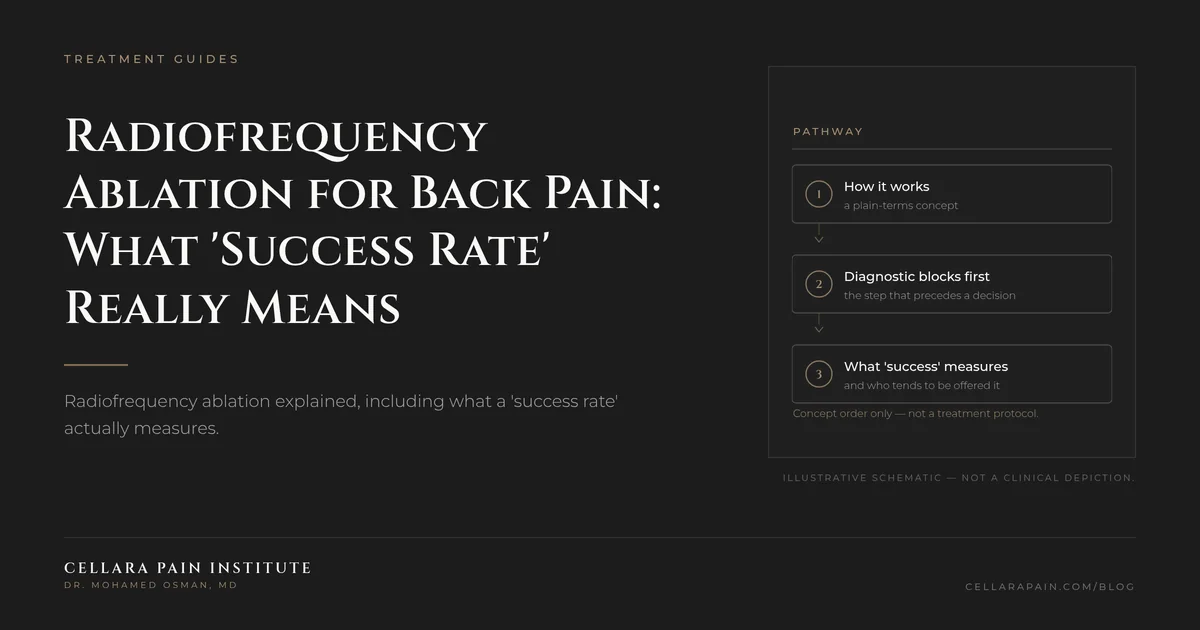
# Radiofrequency Ablation for Back Pain: What "Success Rate" Really Means Short answer: Radiofrequency ablation (RFA) uses heat from a small needle to interrupt the specific nerves that carry pain signals from spinal joints. The percentage figures you see online are not personal predictions — they are study-population results that depend heavily on patient selection, and the single biggest factor in selection is whether diagnostic blocks correctly identified the pain generator. In a systematic review, successful pain relief after radiofrequency treatment ranged from about 30% to 50%.[1] That range is the honest headline, and it is worth understanding rather than skimming past. RFA is not a treatment for "back pain" in general. It is a treatment for one specific, testable diagnosis: pain coming from a spinal facet joint, carried by a known nerve, in a patient whose diagnostic blocks confirmed it.
01
How the procedure works, in plain terms
Facet joints are the small joints at the back of each spinal segment. When they become arthritic or irritated, the pain is often felt as a deep ache, worse with extension, standing, or twisting, and it can refer into the buttock or thigh without following a nerve-root pattern into the foot.
Each facet joint is supplied by a medial branch nerve. RFA places a needle near that nerve and delivers radiofrequency energy, which creates a small heat lesion that interrupts the pain signal. The nerve is not destroyed permanently — it regenerates — which is why relief, when it happens, is typically measured in months, and why the procedure costs the patient nothing structurally.
Two consequences follow from that anatomy:
- The target must be identified first. If the wrong medial branch is treated, the procedure fails regardless of technique.
- The intervention is reversible and repeatable. Regrowth of the nerve means the effect fades; it is not a one-time surgical fix.
02
Why diagnostic blocks come first
The multi-specialty consensus guideline on lumbar facet interventions is explicit that lumbar medial branch RFA may provide benefit to well-selected individuals, and that medial branch blocks are more predictive than intra-articular (into-the-joint) injections.[2] In other words: the injection that tells you whether the joint is the source is more useful than the one that treats it empirically.
That is why a proper pathway looks like this:
- History and exam consistent with facet-mediated pain.
- Diagnostic medial branch block(s) — a small amount of local anesthetic placed on the nerve. If pain drops substantially and briefly, the nerve is implicated.
- A second confirmatory block in many protocols, to reduce false positives. The consensus document notes that even among specialists, agreement on the number of blocks and the cut-off for calling a block "positive" required explicit consensus-building — variations exist and are acceptable when clinically justified.[2]
- Radiofrequency ablation, only if the blocks were positive.
- A defined follow-up to measure functional change, not just a pain score.
If a clinic offers RFA without diagnostic blocks, ask why. The step is not bureaucracy; it is the difference between treating a confirmed pain generator and treating a guess.
03
What the evidence does and does not support
Supported: Carefully selected patients with confirmed facet-mediated pain can experience meaningful relief after medial branch RFA, and the intervention is well established in interventional practice, with consensus guidance from a multi-specialty international working group.[2] Because it targets nerves rather than joints, it does not rely on steroid and can be used when steroid injections are not advisable or have not lasted.
Not supported: the idea that RFA reliably fixes back pain in general, that it is a permanent solution, or that "70-80% success" claims found in marketing material apply to a given individual. Population responder rates in the literature sit in the range cited above, and much of the variability is explained by selection rather than by the technology.[1][2]
Be cautious about any source that presents a single number without describing who was selected, how the diagnosis was confirmed, and how success was measured. Those three details determine whether the number means anything for you.
04
Side effects and risks
Radiofrequency procedures carry a small but real risk profile. A review of radiofrequency ablation for spinal pain describes complications as uncommon, and lists infection, hemorrhage, numbness or dysesthesia in the treated area, and increased pain around the procedure site as the events to know about.[1]
- Expected after the procedure: soreness and a temporary increase in pain for days to a few weeks while the nerve lesion settles. This is common and does not mean the procedure failed — which is why the follow-up usually occurs several weeks later, not the next day.
- Possible: a patch of numbness or altered sensation; usually temporary, occasionally longer-lasting.
- Uncommon but important: infection, bleeding, or nerve injury. Certain regions require more caution than others: the same review notes that cervical facet radiofrequency treatment calls for confirming the diagnosis with double blocks before proceeding, because the anatomy raises the stakes.[1]
- Not for everyone: people with active infection, significant bleeding risk, or an implanted device in the path of the current need a specific assessment first.
05
Red flags that outrank any procedure decision
Do not schedule an elective procedure on top of these symptoms. Seek urgent care for new saddle-area numbness, new difficulty starting urination or loss of bowel control, rapidly progressing leg weakness, or fever with new back pain. These can signal cauda equina syndrome or infection, both of which are emergencies — cauda equina syndrome accounts for about 3% of disc herniations and is treated surgically, not with injections.[3]
06
FAQ
How long does relief last? When it works, relief is typically measured in months, because the nerve regenerates. Some patients return for repeat treatment; the decision should be based on whether the first one produced a functional improvement.
Is RFA surgery? No. It is a needle-based procedure performed outside the spinal canal, without an incision or general anesthesia in most cases.
Will it hurt? The procedure itself is usually tolerated with local anesthetic. The days after can be uncomfortable; that post-procedure flare is expected.
What if the diagnostic block helps but only for a few hours? That short, temporary relief is exactly the signal being tested — it suggests the nerve is the right target. The duration of the block is not the treatment; it is the diagnostic clue.
Can I skip the blocks and go straight to ablation? You can find providers who will. It substantially raises the chance of an unnecessary procedure, because facet pain cannot be confirmed reliably without them.[2]
Is radiofrequency ablation usually covered by insurance? Many plans cover it with prior authorization and documented diagnostic blocks, but criteria vary by plan and are not something this article can state for you. Ask both your insurer and the office to confirm before scheduling.
07
What to do next
If your back pain is worse with standing and bending backward, has lasted months, and has not responded to physical therapy, the useful question is not "should I have RFA?" but "is a facet joint my pain generator?" That question has a testable answer. At Cellara Pain Institute in Langhorne, PA, evaluation includes a neurologic exam and a structured review of your imaging and prior treatments, followed by a plan that names the next step and what it is meant to rule in or out.
Book a consultation to find out whether a diagnostic pathway makes sense for your symptoms.
08
References
- Radiofrequency Ablation for the Management of Pain of Spinal Origin in Orthopedics. PMC10697193. https://pmc.ncbi.nlm.nih.gov/articles/PMC10697193/ — accessed 2026-09-16.
- Consensus practice guidelines on interventions for lumbar facet joint pain from a multispecialty, international working group. Regional Anesthesia & Pain Medicine. https://rapm.bmj.com/content/early/2020/04/03/rapm-2019-101243 — accessed 2026-09-16.
- StatPearls (NCBI Bookshelf). Cauda Equina and Conus Medullaris Syndromes. https://www.ncbi.nlm.nih.gov/books/NBK537200/ — accessed 2026-09-16.
Ready to talk about your care?
Book a consultation
A consultation gives you time to discuss your history, questions, and treatment options with a specialist.
Book a Consultation