Understanding Pain
Nerve Pain vs. Muscle Pain: How To Tell the Difference
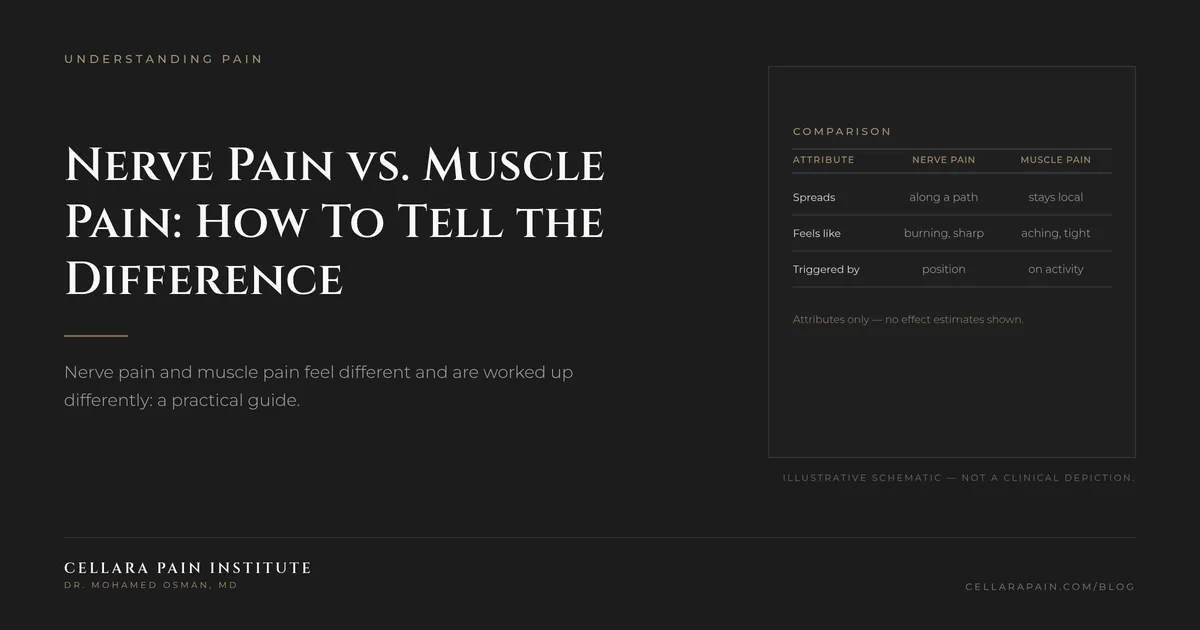
# Nerve Pain vs. Muscle Pain: How To Tell the Difference Short answer: Nerve pain tends to travel in a path, is often described as burning, electric, shooting, or tingling, and can come with numbness, weakness, or reflex changes. Muscle pain is usually achy and localized, worsens with use and eases with rest, and does not produce neurologic deficits. The difference matters because the treatments are different — and because treatments aimed at the wrong tissue produce the familiar experience of doing everything right and still hurting. This is a differentiation exercise that clinicians perform with an exam, not a questionnaire, but there are features you can observe and describe that make the evaluation much more efficient.
01
Features that point to nerve pain
- A path, not a patch. Symptoms follow a nerve distribution — a strip down the leg below the knee, a specific set of fingers, a band around the torso. "It goes from here to there in a line" is more nerve-like than "my whole thigh aches."
- Character. Burning, electric, shooting, pins-and-needles, or a sense of cold or wetness in a numb area. Sharp, brief, electric sensations are highly suggestive.
- Accompanying neurologic signs. Numbness, tingling, weakness in a specific movement (catching the toe, lifting the arm), or a change in reflexes.
- Worse with nerve tension. Bending the neck or lifting a straight leg can change the symptoms in the far end of the limb.
- Present at rest and at night. Nerve pain often does not require use to appear.
Nerve-root irritation — radiculopathy — is usually caused by a disc herniation or by degenerative narrowing where the root exits. Nucleus pulposus herniation is the most common cause of sciatic pain, with an estimated prevalence of roughly 1% to 3%, and it is a leading indication for spine surgery worldwide.[1]
02
Features that point to muscle pain
- Localized and reproducible. You can point to it. Pressing on it reproduces it. Activity that loads it reliably reproduces it.
- Achy rather than electric. Described as tightness, soreness, cramping, or a deep dull ache.
- No neurologic deficits. Reflexes, strength, and sensation are intact.
- Position-dependent rather than nighttime-dependent. Rest, heat, and gentle movement ease it; sustained load worsens it.
- Trigger points. A taut band with a hypersensitive spot that refers pain on compression is the classic myofascial pattern.
Myofascial pain is real and common — and also frequently over-claimed online. The honest position is that the evidence for many myofascial interventions is mixed, and the label should not be applied to pain that has not been properly evaluated. Piriformis syndrome is a good illustration: it is a genuine cause of gluteal radiating pain due to sciatic nerve entrapment, and it is diagnosed clinically, but it overlaps substantially with other causes of the same pain pattern.[2]
03
The overlap problem — and why it matters
Many people have both. A tight, overloaded muscle can aggravate a nearby nerve. A nerve injury can change how muscles fire, producing secondary muscle pain. And in a striking number of cases, the true driver is neither: facet joints, sacroiliac joints, and hip pathology all produce pain that gets labeled as muscle strain.
Guidelines reinforce the caution: imaging findings such as disc degeneration and facet arthritis are common in people without pain, so a scan alone does not identify the generator.[3]
04
How clinicians separate them
- History: where it starts, where it goes, how far it travels, what provokes it, what it feels like, and whether it wakes you.
- Neurologic exam: reflexes, sensation, and strength mapped to nerve roots.
- Nerve-tension and joint provocation testing: straight-leg raise, hip and facet provocation.
- Palpation and resisted movement: to reproduce muscular patterns.
- Targeted testing when needed: electrodiagnostic studies for ambiguous nerve involvement, or diagnostic injections to confirm a suspected generator.
05
Why the distinction changes treatment
- Nerve pain from a disc or nerve root: most cases improve over weeks. Imaging is not indicated without red flags unless symptoms persist for roughly six weeks.[4] When pain persists, targeted options such as epidural steroid injection may be considered for short-term relief of radicular pain, and surgical referral is reserved for selected cases.[3][5]
- Facet-mediated pain: approached through the joint's nerve supply, with diagnostic blocks as the confirmatory step, since medial branch blocks predict response better than joint injections.[6]
- Muscle and myofascial pain: graded activity, load management, and a stretching and strengthening program, with targeted injections considered in persistent cases.
- Neuropathic pain that is not compressive — for example, diabetic neuropathy — is managed on a different pathway entirely, often with medication and foot care.
Treating nerve pain with stretching alone, or muscle pain with injections alone, is how patients end up cycling through treatments without progress.
06
Red flags — do not wait on these
Seek emergency care for new saddle-area numbness, new difficulty starting urination or loss of bowel control, rapidly progressive leg weakness, fever with new back pain, or severe pain after trauma. Cauda equina syndrome is a surgical emergency occurring in roughly 3% of disc herniations.[7]
07
FAQ
Can muscle pain turn into nerve pain? Sustained muscle tension can irritate a nearby nerve, and nerve irritation can alter muscle function — so the two can feed each other. That is one reason a single-diagnosis approach sometimes stalls.
How can I tell at home? Describe the pattern, not just the intensity: does it travel in a line, is it electric or achy, and does it come with numbness or weakness? Those three answers are what a clinician needs first.
Do I need an MRI to figure this out? Usually not at the outset. An exam can often separate nerve from muscle involvement, and imaging is most useful when it answers a specific question.[4]
Are trigger point injections effective? They are used for myofascial pain, and the evidence varies by study and by how carefully the diagnosis is confirmed. They should not be a substitute for an evaluation that rules out nerve and joint generators.
Who should I see first? Start with your primary care clinician for the initial assessment. If symptoms persist, recur, or include neurologic signs, evaluation by a specialist who examines nerve and joint generators — and can offer diagnostic confirmation — is a reasonable next step.
08
What to do next
Bring the pattern: where it starts, how far it travels, what it feels like, and whether anything feels numb or weak. At Cellara Pain Institute in Rosemont, PA, evaluation of leg, back, and neck pain starts by separating nerve, joint, and muscle generators with an exam and a review of your existing imaging — then matching the treatment to the finding.
Book a consultation to find out what is actually generating the pain before choosing a treatment.
09
References
- StatPearls (NCBI Bookshelf). Nucleus Pulposus Herniation. https://www.ncbi.nlm.nih.gov/books/NBK542307/ — accessed 2026-09-16.
- StatPearls (NCBI Bookshelf). Piriformis Syndrome. https://www.ncbi.nlm.nih.gov/books/NBK448172/ — accessed 2026-09-16.
- American Family Physician. Chronic Low Back Pain in Adults: Evaluation and Management (2024). https://www.aafp.org/afp/2024/0300/chronic-low-back-pain — accessed 2026-09-16.
- StatPearls (NCBI Bookshelf). Disk Herniation. https://www.ncbi.nlm.nih.gov/books/NBK441822/ — accessed 2026-09-16.
- Efficacy of epidural steroid injection in sciatica secondary to lumbar disc herniation: systematic review and meta-analysis. https://pmc.ncbi.nlm.nih.gov/articles/PMC11150834/ — accessed 2026-09-16.
- Consensus practice guidelines on interventions for lumbar facet joint pain. Regional Anesthesia & Pain Medicine. https://rapm.bmj.com/content/early/2020/04/03/rapm-2019-101243 — accessed 2026-09-16.
- StatPearls (NCBI Bookshelf). Cauda Equina and Conus Medullaris Syndromes. https://www.ncbi.nlm.nih.gov/books/NBK537200/ — accessed 2026-09-16.
Ready to talk about your care?
Book a consultation
A consultation gives you time to discuss your history, questions, and treatment options with a specialist.
Book a Consultation