Cellara Journal
Forefoot Pain: Morton's Neuroma vs Metatarsalgia
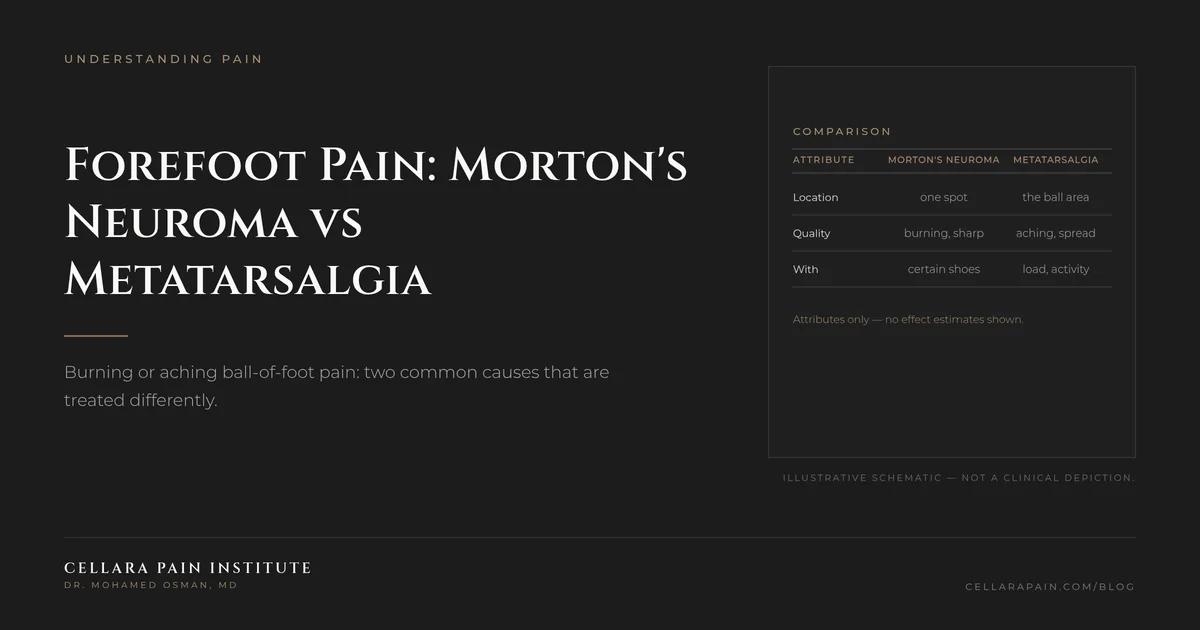
# Forefoot Pain: Morton's Neuroma vs Metatarsalgia Short answer: Morton's neuroma is a thickened, fibrosed digital nerve in the ball of the foot, causing sharp or burning pain that often feels like a pebble in your shoe. Metatarsalgia is more generalised pain under the metatarsal heads from pressure and overload. They feel similar at first but are treated differently — and getting the label right matters.
01
Why the distinction matters
Both cause ball-of-foot pain, and both respond to footwear changes. But a neuroma is a nerve problem, while metatarsalgia is a pressure and load problem affecting the structures under the metatarsal heads. Nerve-targeted treatments, including certain injections, are appropriate for a neuroma and not simply transferable to metatarsalgia.
02
Morton's neuroma
Morton's neuroma is not actually a tumour or a true neuroma. It is fibrosis of the digital nerve caused by pressure or repetitive irritation, causing the nerve to thicken in the second or third intermetatarsal space — most commonly the third [1].
Typical features:
- Sharp, burning or stabbing pain in the ball of the foot
- Often described as feeling like you are standing on a pebble or a folded sock
- Pain that radiates toward the toes
- Worse in narrow or pointed shoes, or with heeled footwear — which increases pressure over the forefoot [1]
- Relief when you take the shoe off and rub the foot
- Numbness or tingling in adjacent toes in some cases [2]
How it is assessed: Clinical examination is central — squeezing the forefoot while palpating the intermetatarsal space often reproduces the pain. Imaging (ultrasound or MRI) can support the diagnosis but is not always necessary; findings must be correlated with what your examination shows.
03
Metatarsalgia
Metatarsalgia is pain and inflammation in the region of the metatarsal heads — the "ball" of the foot. It is a symptom pattern rather than a single disease, and causes include:
- High-impact activity with inadequate footwear
- High arches or very flexible flat feet
- Prominent metatarsal heads or a long second toe
- Tight calf muscles increasing forefoot load
- Inflammatory arthritis or gout in some cases
- Stress fractures of the metatarsals (an important mimic) [3]
Typical features:
- Dull, aching pain under the ball of the foot
- Worse with standing, walking, or barefoot on hard floors
- Callus formation under the painful area
- Pain that builds with activity rather than sharply shooting
04
Side-by-side
| Morton's neuroma | Metatarsalgia | |
|---|---|---|
| Structure involved | Digital nerve (fibrosed) | Metatarsal head region / soft tissue |
| Character | Sharp, burning, shooting | Dull, aching, pressure-like |
| Classic description | Pebble in the shoe | Bruised ball of the foot |
| Shoe association | Narrow/heeled shoes aggravate markedly | Impact and standing load aggravate |
| First-line treatment | Wider, cushioned footwear; metatarsal pad | Footwear, orthotics, load reduction |
| Injection role | Sometimes used around the nerve | Depends on the underlying cause |
05
Treatment: what actually helps
Morton's neuroma
- Footwear change — wider toe box, lower heel, cushioned sole. This is the single most effective first step.
- Metatarsal pads — placed just behind the painful area to spread the metatarsals.
- Activity modification and load reduction.
- Injection — corticosteroid injection around the neuroma is used to reduce symptoms in some patients; it does not remove the neuroma.
- Surgical excision — considered for persistent, disabling cases, usually via a dorsal approach; careful patient selection and pre-operative counselling are emphasised in the literature as central to a good result [1].
Metatarsalgia
- Footwear and cushioning — padded insoles, avoiding hard flat shoes for prolonged standing.
- Orthotics to redistribute pressure.
- Calf and plantar fascia flexibility work — tight calves increase forefoot load.
- Load management with gradual return to impact activity.
- Treat the underlying cause if inflammatory arthritis or gout is present.
- Address stress fracture if imaging shows one — this changes management entirely.
06
Realistic expectations
Both conditions commonly improve with consistent footwear and load changes over weeks to a few months. Neither tends to resolve in days. Patients who return to the same narrow shoes or the same high-volume standing schedule often flare again — footwear is not optional here, it is the treatment.
07
Red flags in forefoot pain
Get evaluated promptly for:
- Sudden severe pain with swelling and bruising after activity — possible metatarsal stress fracture
- A hot, red, swollen foot with fever — possible infection
- Burning pain in both feet, worse at night — this pattern suggests a generalised neuropathy rather than a local neuroma (see our neuropathy article)
- Foot pain in diabetes with reduced sensation — urgent foot review
- Numbness that is progressive or spreading up the leg
08
FAQ
Will a neuroma go away on its own? Symptoms often improve substantially with footwear changes, though the thickened nerve itself does not disappear.
Do injections cure a neuroma? They can reduce symptoms for a period. They do not remove the neuroma.
Should I have surgery first? No. Sustained conservative care with proper footwear and padding comes first in almost all cases.
Is it safe to keep walking? Within tolerance, yes — but the shoe you walk in matters more than the distance.
09
Bottom line
Forefoot pain is usually a mechanical problem with a footwear solution, but the label — neuroma versus metatarsalgia versus stress fracture versus neuropathy — determines the treatment. Wide, cushioned shoes and metatarsal padding resolve or substantially improve most cases. Injections have a role in neuroma symptoms; surgery is a last resort.
Cellara Pain Institute in Langhorne, PA evaluates forefoot and foot pain to identify whether the source is nerve, joint or load — before recommending treatment.
10
References
- Morton's neuroma: current concepts review — https://pmc.ncbi.nlm.nih.gov/articles/PMC7211826/
- Mayo Clinic: Morton neuroma — symptoms and causes — https://www.mayoclinic.org/diseases-conditions/mortons-neuroma/symptoms-causes/syc-20351935
- Cleveland Clinic: Morton's neuroma — https://my.clevelandclinic.org/health/diseases/15118-mortons-neuroma
Ready to talk about your care?
Book a consultation
A consultation gives you time to discuss your history, questions, and treatment options with a specialist.
Book a Consultation