Cellara Journal
Functional Pain Management: Why We Measure What You Can Do
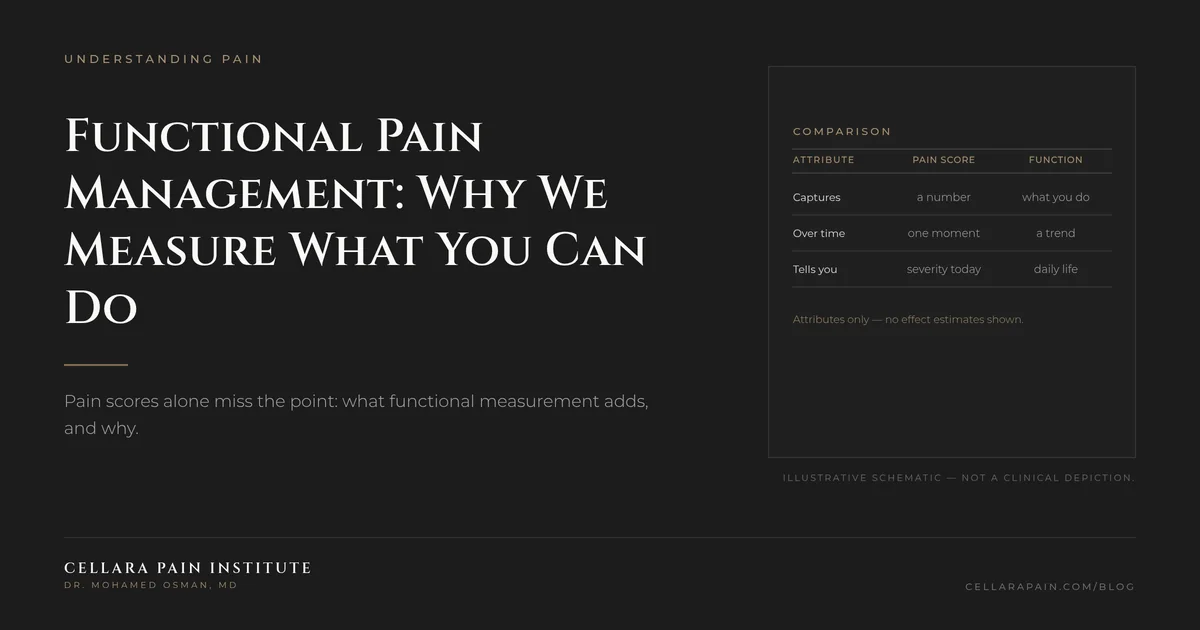
# Functional Pain Management: Why We Measure What You Can Do Short answer: Functional pain management measures what you can actually do — walk, sleep, lift, work, participate — rather than only how bad the pain feels on a 0–10 scale. This matters because a pain score can improve while your life gets smaller, and functional measures catch that. If you have chronic pain, you have probably been asked to rate it on a scale more times than you can count. That number is useful and also incomplete.
01
The problem with pain scores alone
A 0–10 score is quick, and it tracks change. But it has well-known weaknesses:
- It is subjective and varies by day, mood and context. Two people with identical injuries report different numbers.
- It does not capture capability. A score of 5 that lets you work and walk two miles is a very different problem from a score of 5 that keeps you in bed.
- It can improve without your life improving — or worsen while your function actually holds steady.
- It rewards pain reduction as the only goal, when the more meaningful target is usually participation and capability.
The CDC's national data make the distinction explicit: in 2023, 24.3% of U.S. adults had chronic pain, while 8.5% had high-impact chronic pain — the category defined by pain that restricts life and work activities [1]. The second number is the one that tracks suffering and cost, and it is a function measure, not a severity measure.
02
What functional pain management looks like
Instead of asking only "how much does it hurt," the assessment asks "what has pain taken from you, and what are we trying to get back?"
Domains that get measured:
| Domain | Example question |
|---|---|
| Physical function | Can you walk 15 minutes, climb stairs, carry groceries? |
| Pain interference | How much does pain get in the way of daily activities? |
| Sleep | Are you waking at night because of pain? |
| Work and role | Are you missing work, or reducing hours? |
| Mood | Is pain driving anxiety or low mood? |
| Participation | Are you seeing people, doing hobbies, leaving the house? |
Tools that make this measurable. PROMIS (Patient-Reported Outcomes Measurement Information System) measures were developed with NIH support and provide validated, comparable scores for physical function, pain interference and related domains [2][3]. They let a clinician track "can you do more than last time" with real numbers rather than impressions. Other validated instruments used in pain care — ODI, DASH, KOOS, NPRS — serve the same purpose for specific regions.
03
Why this changes treatment decisions
Functional measurement changes the conversation in several practical ways:
- It defines success before treatment starts. "Walk to the mailbox without stopping" is a goal that can be achieved or not, and reviewed honestly.
- It prevents indefinite escalation. If pain scores are unchanged but you can now sleep and work, that is meaningful progress — and grounds for continuing rather than escalating.
- It surfaces problems pain scores hide. Worsening sleep or dropping out of work may matter more than a one-point change in pain.
- It supports honest conversations about injections and procedures. The question becomes "did this get you closer to your function goal," not "did it feel better for a while."
04
What this looks like in a visit
Expect the conversation to cover:
- What you cannot do now that you want to do — stated specifically
- What has changed since last time — in measurable terms
- What your treatment is enabling, not just what it numbs
- Whether the plan should continue, change, or stop
And expect to be asked about sleep, mood and activity, because these interact with pain in both directions. Poor sleep worsens pain perception; untreated low mood makes pain harder to tolerate.
05
Being honest about the limits
Functional management does not mean ignoring pain, and it is not a way to tell patients to live with it. It means:
- Pain relief still matters and is pursued
- The goal is capability, not a zero on a scale
- Progress may be partial and should still count
- Some conditions will not fully resolve, and the plan should reflect that
The CDC's high-impact chronic pain figure — 8.5% of adults — is a reminder that a large number of people are dealing with pain that limits work and daily life, and that pain-limiting-function is the problem worth measuring [1].
06
What you can track yourself
You do not need a clinic's questionnaire to benefit from this approach. Track:
- Distance or duration walked, weekly
- Nights you slept through, per week
- Days you worked or did your normal role
- Activities you regained and ones you lost
- Medication used, and whether it is trending up or down
Bring the list to your appointments. It is often more useful than a remembered pain score.
07
Red flags: function loss that needs urgent attention
New or rapidly worsening function loss is a reason to be seen promptly, not to wait:
- New weakness in an arm or leg (foot drop, hand weakness)
- New bowel or bladder changes with back pain or saddle numbness — emergency
- Rapidly worsening ability to walk over days rather than months
- Fever with new pain or swelling
- Function loss after a fall or injury
08
Bottom line
Pain intensity is worth measuring, but it is a poor sole target. Functional pain management asks what pain has cost you and what you want back — then measures whether treatment is actually getting you there, using validated tools like PROMIS and simple self-tracking. It is a more honest target, and it makes treatment decisions easier to justify and easier to stop when they are not working.
Cellara Pain Institute in Langhorne, PA sets functional goals with patients and reviews progress against them, so treatment decisions are based on what changed rather than how the day felt.
09
FAQ
Does this mean my pain will not be treated? No. Pain relief is still pursued. Functional measurement is added so that relief is connected to something you can actually do.
What if my pain score does not change but I can do more? That counts as progress and is worth continuing. Capability is the goal.
What if my pain score improves but my function does not? That is a signal to look deeper — sleep, mood, deconditioning or an untreated structural problem may be limiting you.
Do I need special questionnaires? No, though validated tools like PROMIS give more comparable numbers. Simple weekly tracking of walking, sleep and work days works well.
Is this just telling patients to live with it? No. It is a way to define what treatment is supposed to achieve and to tell honestly whether it is working.
10
References
- CDC NCHS Data Brief 518: Chronic Pain and High-impact Chronic Pain in U.S. Adults, 2023 — https://www.cdc.gov/nchs/products/databriefs/db518.htm
- Performance of a PROMIS patient-reported outcomes measure — https://pmc.ncbi.nlm.nih.gov/articles/PMC6281027/
- PROMIS pain-related measures: an overview — https://www.medcentral.com/pain/chronic/promis-pain-related-measures-overview
Ready to talk about your care?
Book a consultation
A consultation gives you time to discuss your history, questions, and treatment options with a specialist.
Book a Consultation