Cellara Journal
Cortisone Injections: How Often Is Too Often?
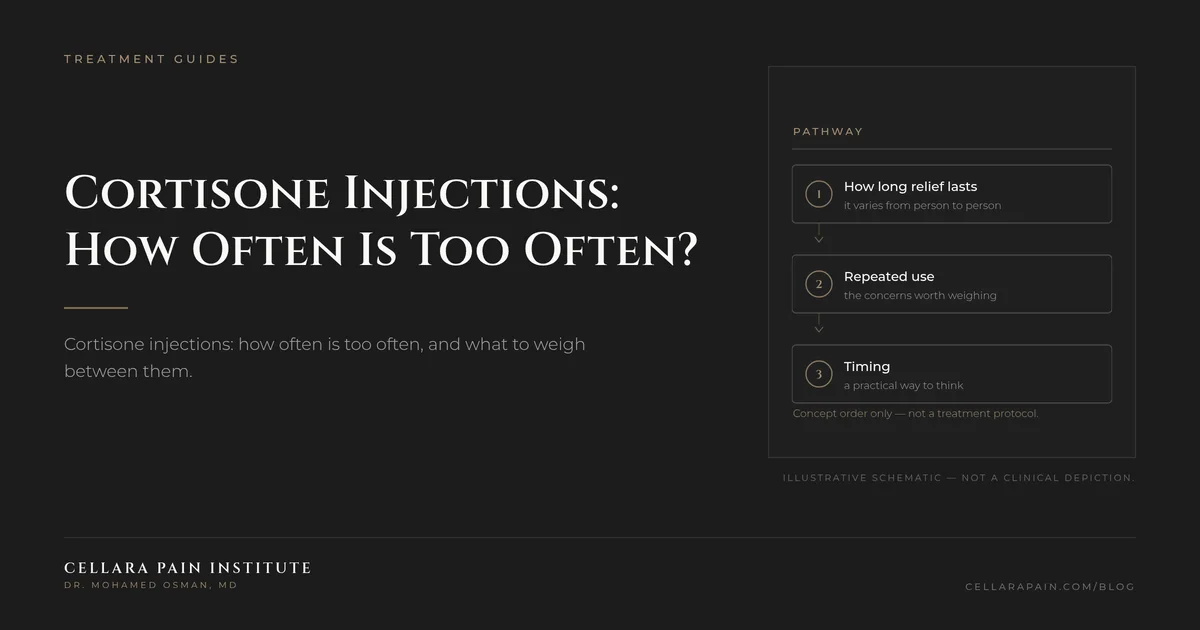
# Cortisone Injections: How Often Is Too Often? Short answer: There is no single agreed numerical limit, but the pattern of use matters more than the count. Steroid injections give real short-term relief — typically up to about twelve weeks in the hip joint — and are best used to enable rehabilitation or to confirm a diagnosis. Frequent repeats without durable benefit are the signal that the plan needs to change, not the dose. Cortisone injections are among the most requested and most useful tools in musculoskeletal medicine. They are also the injection patients are most likely to receive repeatedly without anyone stepping back to ask whether repetition is helping.
01
How long relief actually lasts
This varies by site, and the site-specific evidence matters:
- Hip joint: benefit can last up to about twelve weeks, per a review of intra-articular corticosteroids for hip osteoarthritis [1].
- Knee joint: supported by the AAOS knee osteoarthritis guideline as a short-term option for symptomatic relief — weeks to a few months, not permanent [3].
- Around tendons: the picture is more cautious. A review of corticosteroid injections in tendon lesions documents concerns about the effect of steroids on tendon tissue itself [2].
The pattern is consistent: steroid suppresses inflammation quickly and effectively, and the effect fades. Nothing about it modifies the underlying condition.
02
The real concerns with repeated use
1. Tendon weakening. Around tendons, repeated corticosteroid exposure raises concern about structural weakening and, in the worst case, rupture. This is why many clinicians avoid serial steroid injections into the same tendon.
2. Joint changes in the hip. A systematic review and meta-analysis has examined rapidly progressive osteoarthritis following intra-articular hip corticosteroid injection [4]. In a small number of patients, joint destruction accelerates after injection. It is uncommon, and it is a genuine consideration — particularly if you already have advanced hip arthritis.
3. Masking instead of addressing. Steroid can make a structural problem feel tolerable long enough that the underlying weakness, loading error or instability gets worse. Relief should be used, not just enjoyed.
4. Systemic effects. Even a local injection has some systemic absorption:
- Blood sugar can rise for several days — important if you have diabetes
- Facial flushing, a temporary increase in appetite, and short-term sleep or mood changes are common
- Repeated exposure raises cumulative concerns over years
5. Diminishing returns. If each injection works for a shorter period than the last, that is a message about the disease trajectory, not a reason to increase frequency.
03
A practical way to think about frequency
Rather than a fixed number, use these questions:
| Question | Why it matters |
|---|---|
| What is this injection enabling? | If it is not enabling rehab, activity or diagnosis, ask why |
| How long did the last one last? | Shortening relief means the plan needs revising |
| How many have I had in this joint or tendon in 12 months? | High counts without lasting benefit warrant a review |
| What else is in the plan? | An injection alone is rarely a complete plan |
| What are my alternatives? | Physiotherapy, load management, other injection types, surgical opinion |
As a rule of thumb many clinicians become cautious about going beyond roughly three or four steroid injections into the same joint in a year, and far more cautious about repeated tendon injections — but this is a judgement call based on site, response and risk, not a universal rule. Ask your clinician what their own threshold is and why.
04
Using an injection well
If you do get one:
- Schedule rehabilitation to start immediately, during the window of reduced pain. That is the highest-value use of the relief.
- Address the loading problem that caused the flare — training volume, footwear, work demands.
- Set a review date. Decide in advance when you will judge whether it worked.
- Track it. Note the date, site, and how long relief lasted. Patterns become obvious quickly.
- Consider alternatives deliberately — including hyaluronic acid, PRP where evidence supports it for your indication, or a surgical opinion if the trajectory is clear.
05
Risks to know
- Infection — rare but serious
- Post-injection flare for one to three days
- Skin thinning, lightening or fat atrophy at the site with repeated injections
- Tendon rupture risk with repeated tendon injections
- Rapidly progressive osteoarthritis in the hip after intra-articular injection [4]
- Blood sugar elevation for several days
- No relief
06
Red flags
Do not accept an injection without evaluation if you have:
- A hot, swollen, red joint with fever
- Inability to bear weight after injury
- New numbness, weakness or bowel/bladder change with back pain
- Unexplained night pain with weight loss
- Pain after a fall in someone with reduced bone density
07
FAQ
Can I get a cortisone injection every month? Monthly steroid injections into the same joint are not a standard or safe long-term strategy. If relief is not lasting, the plan needs to change.
Do cortisone injections cause arthritis to get worse? The evidence is not settled for all joints, but in the hip there is a documented association with rapid progression in a small number of patients [4], and tendon concerns exist around tendon injections [2].
Is it safe if I have diabetes? Blood sugar commonly rises for several days. Plan with your clinician, especially if you are insulin-treated.
Do they weaken tendons? Repeated injections around tendons raise concern about tendon structure and rupture [2]. This is why many clinicians limit them.
08
Bottom line
Cortisone is a good short-term tool and a poor long-term strategy. The count matters less than the pattern: if each injection is lasting a shorter time, if nothing else is in the plan, or if you are on a repeating schedule without a review, that is the point to step back and reassess.
Cellara Pain Institute in Langhorne, PA reviews injection history, response duration and alternatives before recommending another steroid injection — and will tell you when the answer should be something else.
09
References
- Intraarticular corticosteroids for hip osteoarthritis: a review — https://pmc.ncbi.nlm.nih.gov/articles/PMC8808783/
- Corticosteroid injections in tendon lesions — https://pmc.ncbi.nlm.nih.gov/articles/PMC1120980/
- AAOS, Management of Osteoarthritis of the Knee (Non-Arthroplasty) CPG — https://www.aaos.org/oak3cpg
- Incidence of rapidly progressive osteoarthritis following intra-articular hip corticosteroid injection — https://www.sciencedirect.com/science/article/pii/S2666061X25000951
Ready to talk about your care?
Book a consultation
A consultation gives you time to discuss your history, questions, and treatment options with a specialist.
Book a Consultation