Understanding Pain
Chronic Back Pain: How a Specialist Evaluation Differs From a Routine Visit
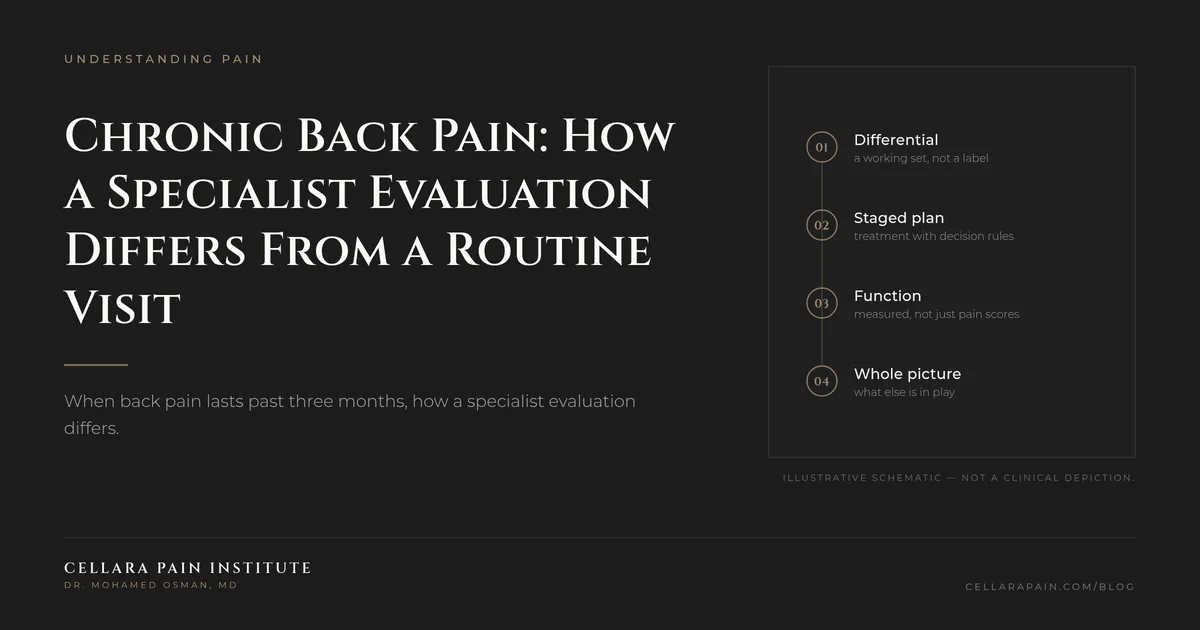
# Chronic Back Pain: How a Specialist Evaluation Differs From a Routine Visit Short answer: Once back pain has lasted twelve weeks or more, the questions change. Instead of "what will settle it?" the useful questions become: which structure is generating this, how much of the pain is driven by nerve sensitivity versus load intolerance, what has already been tried and with what result, and what measurable goal are we aiming for. A specialist evaluation is built around those four questions — which is why it can produce a different plan than another round of the same advice. Chronic low back pain, defined as persisting twelve weeks or more, affects roughly 13% of U.S. adults.[1] The number is large enough that "chronic back pain" alone is not a diagnosis; it is a category that requires sub-typing before treatment decisions make sense.
01
Difference one: it produces a differential, not a label
A routine visit often ends with a management phrase: rest, ice, physical therapy, follow up as needed. A specialist evaluation should end with a short list of candidate causes, ranked, with the reasoning stated.
Common candidates and what distinguishes them:
- Facet-mediated pain — deep, achy, worse with standing and extension, referring into the buttock or thigh without following a nerve root. It is testable with a diagnostic medial branch block, and the consensus guideline notes that medial branch blocks predict response to radiofrequency treatment better than injections into the joint itself.[2]
- Radicular pain (nerve root) — travels in a nerve pattern, often below the knee, and responds to nerve-tension testing. When pain persists, epidural corticosteroid injection may be considered for short-term relief in this subset specifically.[3][4]
- Discogenic pain — midline, worse with sitting and bending forward.
- Sacroiliac or hip-driven pain — often felt in the buttock, groin, or thigh, frequently missed when the exam stays focused on the lumbar spine.
- Centralized or mixed pain — pain amplified and spread beyond the original site, where the most effective levers are graded activity, sleep, and psychological approaches rather than escalation of procedures.
If a plan does not name which candidate is being treated, the treatment is working blind. That is the single most common problem in long-running back pain care.
02
Difference two: it stages treatment with decision rules
Guidelines converge on a staged, least-invasive-first approach, and the staging matters more than the menu:
- First-line, nonpharmacologic: exercise therapy, counseling, spinal manipulation, massage, heat, acupuncture, and transcutaneous electrical nerve stimulation. For chronic pain specifically, exercise and multidisciplinary rehabilitation carry the strongest support among these.[1][5]
- Medication, when needed: NSAIDs are the initial choice; duloxetine may be beneficial. The evidence is inconclusive for benzodiazepines, long-term muscle relaxants, anticonvulsants, acetaminophen, cannabis, and long-term opioids.[1]
- Targeted intervention: injections and nerve procedures when a specific generator has been identified — not as a default response to duration.[2][3][4]
- Surgical opinion: when function is severely limited despite appropriate care, or when a neurologic deficit is progressing.
Each stage should carry a time box and a decision rule. "Try physical therapy" is not a stage; "try a six-week graded program, then reassess walking distance and whether a diagnostic block is warranted" is.
03
Difference three: it measures function, not just pain scores
Pain intensity is one data point. The measures that tell you whether the plan is working are functional: how far you can walk, whether you are sleeping through the night, whether you have returned to work, how many days per month pain keeps you from normal activity.
Ask for these to be written down at the first visit and re-checked at follow-up. Functional targets also make the difference between a treatment that "feels like it might be helping" and one that is demonstrably helping.
04
Difference four: it addresses the whole picture
Chronic pain is affected by sleep, mood, stress, and deconditioning, and those factors are not secondary — they change how much any treatment can accomplish.[1] A specialist evaluation should ask about sleep quality, mood and anxiety, work demands, and any prior adverse experiences with care. The 2022 VA/DoD low back pain guideline is explicitly built around patient-centered care and shared decision-making rather than a fixed algorithm applied to everyone.[5]
That is also where the frustration many patients arrive with comes from: pain that has been managed with a series of disconnected treatments, each assessed on its own, with no one looking at the whole.
05
What to bring to a chronic pain evaluation
- Imaging discs and reports (the images, not only the report).
- A written list of every treatment tried, with dates, duration, and outcome.
- Current medications and doses, including over-the-counter use and supplements.
- A three-day pain and activity diary if you can keep one.
- Your own functional goal — stated concretely: "walk the dog for twenty minutes without stopping."
06
Red flags still apply
Chronic pain does not exempt anyone from emergencies. Seek emergency care for new saddle-area numbness, new bladder or bowel dysfunction, rapidly progressive leg weakness, fever with new back pain, or severe pain after trauma. Cauda equina syndrome affects roughly 3% of disc herniations and is a surgical emergency.[6]
07
FAQ
Do I need a referral to see a pain specialist? It depends on your insurance plan. HMO-type plans commonly require a referral; many PPO plans do not. Confirm with your insurer before scheduling.[7]
What if my imaging is unremarkable? That is common and does not mean the pain is unreal. Imaging findings such as disc degeneration and facet arthritis appear in people without pain, so the exam and symptom pattern carry much of the diagnostic weight.[1][2]
Will the first visit include a procedure? Usually not. A procedure follows a diagnosis and often requires prior authorization. The first visit's job is to establish what is generating the pain.
How long before a plan shows something? Stages should be time-boxed — often four to six weeks per stage — with a defined review. If nothing is being measured, that should be corrected before more treatment is added.
Can chronic pain be reduced without opioids? Guidelines place nonpharmacologic approaches first and reserve opioids for selected cases after other treatments have not helped, weighing benefits against the substantial risks.[1][5]
08
What to do next
A chronic pain evaluation should answer one question you can repeat back: what is generating this pain, and what is the next step to confirm or treat it? At Cellara Pain Institute in Langhorne, PA, evaluation of persistent back pain includes a neurologic exam, a structured review of every treatment you have already tried, and a written plan with a functional target and a review date.
Book a consultation to replace another round of the same advice with a plan that has a decision rule.
09
References
- American Family Physician. Chronic Low Back Pain in Adults: Evaluation and Management (2024). https://www.aafp.org/afp/2024/0300/chronic-low-back-pain — accessed 2026-09-16.
- Consensus practice guidelines on interventions for lumbar facet joint pain from a multispecialty, international working group. Regional Anesthesia & Pain Medicine. https://rapm.bmj.com/content/early/2020/04/03/rapm-2019-101243 — accessed 2026-09-16.
- Efficacy of epidural steroid injection in sciatica secondary to lumbar disc herniation: systematic review and meta-analysis. https://pmc.ncbi.nlm.nih.gov/articles/PMC11150834/ — accessed 2026-09-16.
- NICE guideline NG59. Low back pain and sciatica in over 16s: assessment and management. https://www.nice.org.uk/guidance/ng59 — accessed 2026-09-16.
- VA/DoD Clinical Practice Guideline for the Diagnosis and Treatment of Low Back Pain (2022). https://www.healthquality.va.gov/guidelines/pain/lbp/ — accessed 2026-09-16.
- StatPearls (NCBI Bookshelf). Cauda Equina and Conus Medullaris Syndromes. https://www.ncbi.nlm.nih.gov/books/NBK537200/ — accessed 2026-09-16.
- HealthCare.gov. Referral (glossary). https://www.healthcare.gov/glossary/referral/ — accessed 2026-09-16.
Ready to talk about your care?
Book a consultation
A consultation gives you time to discuss your history, questions, and treatment options with a specialist.
Book a Consultation