Understanding Pain
Neck Pain That Travels Down the Arm: When It's a Nerve Root
# Neck Pain That Travels Down the Arm: When It's a Nerve Root Short answer: Neck pain that shoots into the shoulder blade, arm, or hand in a specific path is usually cervical radiculopathy — irritation of a nerve root where it exits the cervical spine. The most common causes are a herniated disc in younger adults and degenerative narrowing (spondylosis) in older adults. Most cases improve with non-surgical care, but a small set of symptoms — especially hand clumsiness, imbalance, or weakness in more than one limb — suggests spinal cord involvement and needs prompt evaluation rather than waiting. Neck pain is not a minor complaint in terms of impact: workers with a history of neck pain account for up to 40% of work absenteeism in the literature on cervical radiculopathy.[1] And the symptom burden is often broader than the classic "shooting pain" description — one review notes that a substantial share of the total symptom burden comes from non-traditional complaints such as dizziness, fatigue, or autonomic symptoms.[1]
01
How to tell a nerve root from a stiff neck
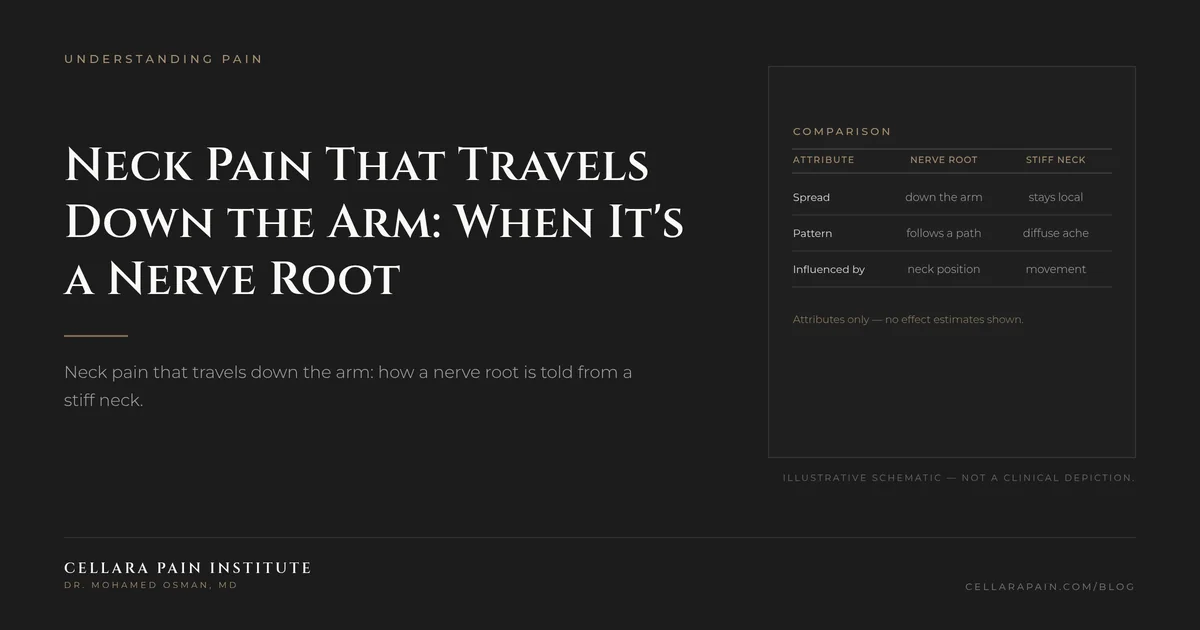
A mechanical neck strain hurts in the neck and upper shoulders, worsens with sustained posture, and eases with movement and time. Radicular pain behaves differently:
- It travels. Pain follows a nerve path — typically from the neck into the shoulder, down the arm, sometimes into specific fingers.
- It has sensory companions. Numbness or tingling in a defined strip of skin, and sometimes a weakened specific movement (lifting the arm, extending the wrist).
- It responds to nerve tension. Turning or tilting the head, or lifting the arm overhead, can change the arm pain rather than the neck pain.
- Reflexes may change at the level involved — a detail that requires an exam, not a search engine.
The nerve-root level determines the pattern, which is why two people with "neck pain down the arm" can have entirely different clinical pictures — and why the exam tries to name the level before anything is injected or treated.
02
What causes it
Disc herniation. Nucleus pulposus herniation is the most common cause of radicular pain in the lumbar spine and the second most common cause in the cervical spine after degenerative spondylosis.[2] Disc material pressing on or chemically irritating a nerve root produces the classic arm pain.
Degenerative spondylosis. With age, disc height loss, bone spurs, and foraminal narrowing reduce the space the nerve root has to exit. Symptoms often come on gradually rather than with a single event. This is the predominant mechanism in older adults.[2]
Other, less common causes should stay on the differential: infection, tumor, fracture, and inflammatory conditions — which is exactly why red flags are screened for first.
03
What non-surgical care looks like
For most people without progressive neurologic deficits, the initial path is non-surgical. The evidence base here is imperfect and worth describing honestly: in cervical disc herniation specifically, there is no clear evidence that conservative treatment is inferior to surgery, and randomized comparisons in the lumbar spine show that early surgery relieves pain faster while long-term outcomes at one to two years are similar.[2]
A reasonable non-surgical plan usually includes:
- Activity modification, not immobilization. Prolonged collar use and complete rest tend to make things worse over time.
- A graded physical therapy program aimed at the neck and shoulder girdle, plus posture and load management for desk and device work.
- Medication used deliberately. NSAIDs for a defined period; the evidence for many other agents in neck pain is weaker than marketing implies.
- Targeted injections when pain blocks progress. Where a specific nerve root is implicated, cervical epidural steroid injection may be considered for short-term relief of radicular pain, following the same logic used in the lumbar spine.[3] Cervical procedures carry higher anatomic stakes, and the radiofrequency literature is explicit that cervical facet interventions should be preceded by double diagnostic blocks.[4]
- Surgical consultation for specific indications — progressive weakness, cord involvement, or pain that remains disabling despite appropriate non-surgical care.
Decision points matter more than the menu. A plan should name what will be tried, for how long, and what would trigger the next step.
04
Symptoms that need urgent attention
These are not "make an appointment next month" symptoms. Seek emergency care for:
- Weakness in more than one limb, or difficulty walking — possible spinal cord compression (myelopathy).
- Clumsy hands — dropping objects, trouble with buttons or handwriting that is new.
- Bowel or bladder changes, or numbness in the saddle area — possible cauda equina syndrome, an emergency occurring in roughly 3% of disc herniations.[5]
- Severe neck pain after trauma, especially with midline tenderness.
- Fever, unexplained weight loss, or a cancer history with new severe neck pain.
05
FAQ
How long does cervical radiculopathy last? Many cases improve over weeks to a few months with non-surgical care, though the timeline varies and depends on the cause. Persistent or worsening deficits change the plan sooner.
Should I have an MRI right away? Imaging is most useful when it answers a question the exam raised — a suspected nerve root level, a deficit, or a red flag. Guidelines caution against routine early imaging for ordinary back and neck pain in the absence of those features.[6]
Are neck injections dangerous? Any injection near the cervical spine carries a small risk of serious complications, which is why cervical procedures are performed with additional safeguards and confirmatory diagnostic steps.[4] The risk-versus-benefit question is individual and belongs in a conversation with the clinician performing it.
Can a chiropractor fix it? Spinal manipulation is included in guideline-listed non-pharmacologic options for low back pain, and some people find manual therapy helpful for neck symptoms; the choice should follow a diagnostic assessment, especially if there is any neurologic deficit.
Does sleeping position matter? Sustained positions matter more than any single night. A supportive pillow and avoiding prolonged end-range positions can reduce symptom flares, but position changes do not treat a compressed nerve root.
06
What to do next
If your arm pain has a path, changes with head position, or comes with numbness or weakness, the useful step is a neurologic exam that identifies the level involved — and a plan that says what will be done if non-surgical care does not work. At Cellara Pain Institute in Langhorne, PA, evaluation of neck and arm pain starts with that exam, a review of any imaging you already have, and a plain-language explanation of what the findings mean.
Book a consultation to find out what is actually causing the arm pain.
07
References
- StatPearls (NCBI Bookshelf). Cervical Radiculopathy. https://www.ncbi.nlm.nih.gov/books/NBK441828/ — accessed 2026-09-16.
- StatPearls (NCBI Bookshelf). Nucleus Pulposus Herniation. https://www.ncbi.nlm.nih.gov/books/NBK542307/ — accessed 2026-09-16.
- American Family Physician. Chronic Low Back Pain in Adults: Evaluation and Management (2024) — epidural corticosteroid injection evidence in radicular pain. https://www.aafp.org/afp/2024/0300/chronic-low-back-pain — accessed 2026-09-16.
- Radiofrequency Ablation for the Management of Pain of Spinal Origin in Orthopedics. PMC10697193. https://pmc.ncbi.nlm.nih.gov/articles/PMC10697193/ — accessed 2026-09-16.
- StatPearls (NCBI Bookshelf). Cauda Equina and Conus Medullaris Syndromes. https://www.ncbi.nlm.nih.gov/books/NBK537200/ — accessed 2026-09-16.
- American Family Physician. Mechanical Low Back Pain (2018), imaging recommendations. https://www.aafp.org/afp/2018/1001/p421 — accessed 2026-09-16.
Ready to talk about your care?
Book a consultation
A consultation gives you time to discuss your history, questions, and treatment options with a specialist.
Book a Consultation