Understanding Pain
Why Your Back Pain Isn't Going Away: A Practical Triage Guide
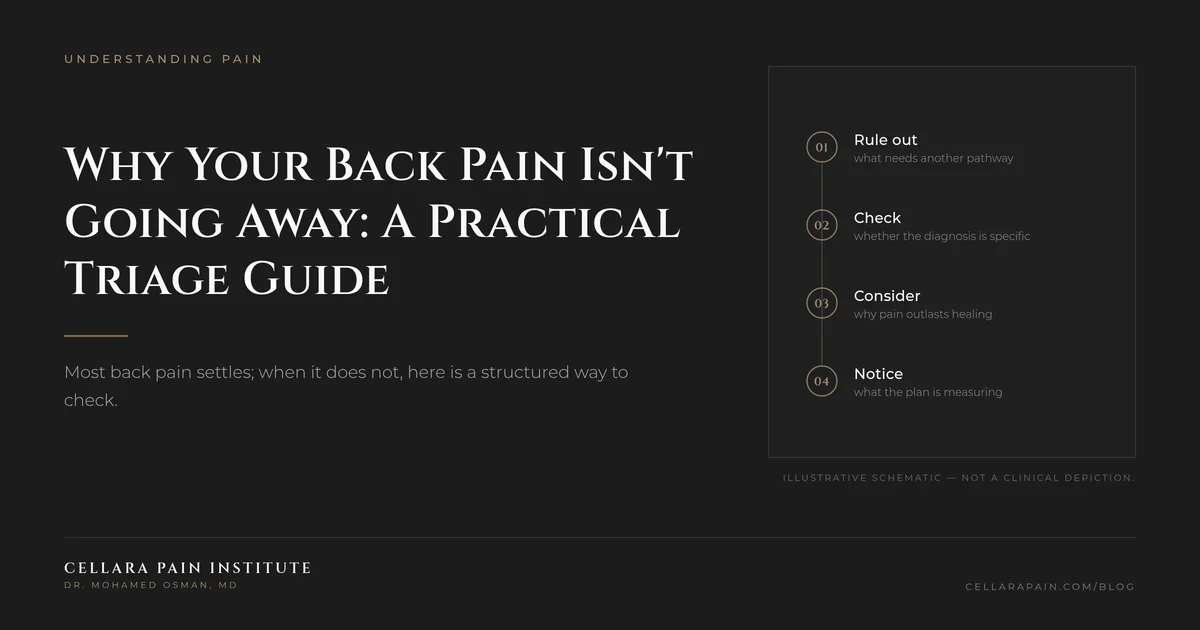
# Why Your Back Pain Isn't Going Away: A Practical Triage Guide Short answer: Most episodes of low back pain improve substantially within a few weeks regardless of treatment.[1] When pain persists, it is usually because one of a small number of explanations is at work: the diagnosis is wrong or too vague, the load is still exceeding what the tissue tolerates, the pain has become nerve-driven or centralized, or something that needs imaging has not been looked for. Persistent pain is a reason to re-examine the plan — not a reason to accept that nothing can be done. Chronic low back pain — defined as lasting twelve weeks or more — affects roughly 13% of U.S. adults, and the lifetime prevalence of low back pain is around 40%.[2] You are not an outlier. But "common" is not the same as "unexplained," and the differences between the explanations change what helps.
01
First, rule out the things that need a different pathway
Before anything else is optimized, a clinician should check for the specific conditions that change urgency. Guidelines are consistent here: initial imaging is not recommended for ordinary low back pain, but it is indicated when red flags are present, when there is a neurologic deficit, or when pain does not resolve with conservative therapy.[2][3]
- Cauda equina syndrome — saddle numbness, new bladder or bowel dysfunction, progressive leg weakness. An emergency; roughly 3% of disc herniations, most from a herniated lumbar disc.[4]
- Infection, fracture, or malignancy — fever, unexplained weight loss, night pain that wakes you, a cancer history, significant trauma, or long-term steroid use. These are the reasons to image early rather than wait.[3][5]
- A progressive neurologic deficit — foot drop, worsening weakness, or numbness that keeps expanding.
If none of those are present, you are in the far more common category where the work is diagnosis and load management, not emergency care. That is good news, and it is also where most frustration lives, because the plan is often vague.
02
Second, check whether the diagnosis is actually specific
"Back pain" is a symptom, not a diagnosis, and treatment aimed at a symptom is often treatment aimed at nothing in particular. Useful categories include:
- Facet-mediated pain — achy, worse with standing, walking downhill, or leaning backward, referring into the buttock or thigh, and testable with a diagnostic medial branch block.[6]
- Radicular pain (sciatica) — leg-dominant, follows a nerve path, often below the knee; the most common cause is a herniated disc, and it is the pattern many interventional treatments target.[7]
- Discogenic pain — deep midline back pain, worse with sitting and bending forward.
- Sacroiliac or hip-driven pain — often felt in the buttock or groin and frequently missed because the exam focuses on the spine.
- Myofascial and deconditioning pain — real, common, and usually responsive to graded activity rather than to procedures.
Different categories point to different treatments. If your current plan has not named which category you are in, that is the first thing to fix.
03
Third, consider why pain outlasts tissue healing
Some of the most persistent pain has less to do with ongoing damage than with how the nervous system has adapted — the "central sensitization" pattern, where pain is amplified and spreads beyond the original site. That does not mean the pain is psychological or imaginary, and it is not a reason to stop looking for a treatable generator. It does mean the most effective approach often shifts: graded exercise, sleep, stress and mood management, and medications such as duloxetine in selected cases, rather than a series of escalating procedures.[2][8]
The chronic-pain guidelines support this layered view. Nonpharmacologic treatment is first-line, including exercise therapy, counseling, spinal manipulation, massage, heat, acupuncture, and transcutaneous electrical nerve stimulation. NSAIDs are the initial medication choice when medication is needed, and the evidence is inconclusive for benzodiazepines, muscle relaxants long-term, acetaminophen, cannabis, and long-term opioids.[2]
04
Fourth, notice what the plan is measuring
A plan that cannot tell you what "better" would look like is not measurable, and unmeasurable plans drift. Ask for:
- A named target. Walk to the mailbox, sleep through the night, return to work, drive forty minutes without stopping.
- A time box. "Reassess in six weeks" beats "come back if it gets worse."
- A decision rule. What result would change the plan — a positive block, no response to therapy, new weakness?
- A clear owner. Who is coordinating the pieces — therapy, medication, procedures, imaging?
Guidelines emphasize shared decision-making and a patient-centered, team-based approach precisely because persistent pain rarely responds to a single intervention applied once.[8]
05
Red flags recap: seek care now, not at the next appointment
Go to an emergency department or call 911 for new saddle-area numbness, new trouble starting urination or loss of bowel control, rapidly progressing leg weakness, fever with new back pain, or severe back pain after significant trauma or with a cancer history.[3][4]
06
FAQ
How long is too long to wait? Most acute episodes improve within about four to six weeks. If pain is not meaningfully better by then — or if it is improving but still limits function at three months — a structured evaluation is reasonable, and imaging may become indicated.[2][3]
My MRI is "normal." Why do I still hurt? Imaging findings such as disc degeneration and facet arthritis are common in people with no pain, and a normal scan does not exclude a pain generator that only provokes with load. The history and exam often carry more diagnostic weight; this is where a specialist evaluation adds value.[2][6]
Does pain that lasts mean damage is getting worse? Not necessarily. Persistent pain often reflects sensitivity and load tolerance rather than progressive structural destruction. That is why the plan should include function measures, not just pain scores.
Should I ask for an injection? The right question is which structure is generating the pain, and whether a test can confirm it. Facet pain has a diagnostic block; radicular pain has its own pathway; myofascial pain generally does not need a procedure.
Is a second opinion worth it? When pain has persisted for months, prior treatments have not worked, and no one has named the pain generator, a focused second evaluation is a reasonable use of time — it either confirms the current plan or changes it.
07
What to do next
If your back pain has outlasted several rounds of the usual advice, bring the whole picture: imaging discs, therapy notes, medication history, and what has and has not helped. At Cellara Pain Institute in Langhorne, PA, the evaluation is built around identifying the pain generator and writing down a plan with a target, a time box, and a decision rule — including what would change the approach.
Book a consultation to get a specific answer instead of another round of waiting.
08
References
- American College of Physicians guideline summary (2017), noninvasive treatments for low back pain. https://www.aafp.org/afp/2017/0915/p407 — accessed 2026-09-16.
- American Family Physician. Chronic Low Back Pain in Adults: Evaluation and Management (2024). https://www.aafp.org/afp/2024/0300/chronic-low-back-pain — accessed 2026-09-16.
- American Family Physician. Mechanical Low Back Pain (2018), imaging recommendations. https://www.aafp.org/afp/2018/1001/p421 — accessed 2026-09-16.
- StatPearls (NCBI Bookshelf). Cauda Equina and Conus Medullaris Syndromes. https://www.ncbi.nlm.nih.gov/books/NBK537200/ — accessed 2026-09-16.
- NIAMS (NIH). Back Pain: Symptoms, Types, and Causes. https://www.niams.nih.gov/health-topics/back-pain — accessed 2026-09-16.
- Consensus practice guidelines on interventions for lumbar facet joint pain. Regional Anesthesia & Pain Medicine. https://rapm.bmj.com/content/early/2020/04/03/rapm-2019-101243 — accessed 2026-09-16.
- StatPearls (NCBI Bookshelf). Nucleus Pulposus Herniation. https://www.ncbi.nlm.nih.gov/books/NBK542307/ — accessed 2026-09-16.
- VA/DoD Clinical Practice Guideline for the Diagnosis and Treatment of Low Back Pain (2022). https://www.healthquality.va.gov/guidelines/pain/lbp/ — accessed 2026-09-16.
Ready to talk about your care?
Book a consultation
A consultation gives you time to discuss your history, questions, and treatment options with a specialist.
Book a Consultation